Almost one-third of all food produced globally never gets eaten, it’s lost somewhere between farm and fork or thrown away by households and businesses. That’s the shocking stat.
The emotional contrast is harder to ignore: the same system that discards edible food also leaves huge numbers of people without enough to eat.
Food waste is a dual crisis. Environmentally, food loss and waste are tied to about 8–10% of annual global greenhouse gas emissions.
Economically, it drives roughly $1 trillion in losses each year, a recurring tax on farmers, companies, cities, and consumers.
This data shows the scale, and food waste technology startups show the pathway, turning wasted food into value with redistribution platforms, kitchen analytics, and AI food waste reduction that directly supports sustainable solutions in the real world.
In this article, we explore 7 types of tech startups solving food waste, along with real-world examples of how each approach is making a measurable impact.
Why Food Waste Is One of the World’s Biggest Hidden Problems
Food waste is “hidden” because it happens across the full value chain:
farm → transport → retail → kitchen → landfill
Global estimates split the problem into two distinct buckets.
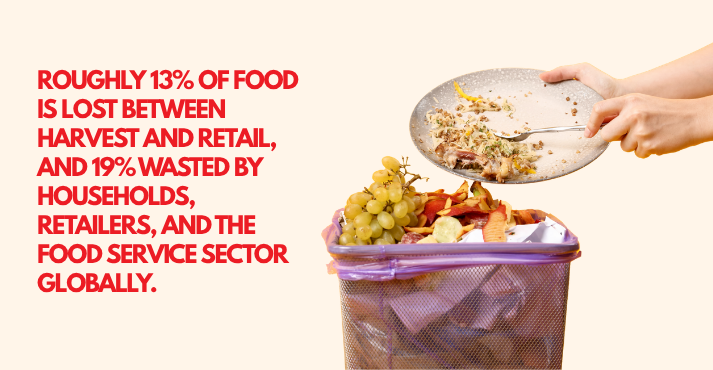
The World Economic Forum estimates that roughly 13% of food is lost between harvest and retail, and 19% wasted by households, retailers, and the food service sector.
That division matters: upstream loss is often about storage, handling, and cold-chain; downstream waste is often about forecasting, purchasing, and habits.
Here are the four key forces that keep the crisis large:
- Climate impact: Wasted production inputs plus methane when organics decompose, contributing to the 8–10% emissions footprint.
- Economic losses: The $1 trillion/year drag shows up as shrinkage and disposal costs.
- Hunger paradox: The world produces enough food for 16 billion people, yet nearly 40% is wasted, a mismatch driven by logistics, incentives, and data gaps as much as production.
- Measurement gaps: Without consistent tracking, waste looks “normal” rather than fixable.
Adding to this, the circular economy food systems reframe the endgame. If food can’t be eaten, keep its value circulating as feed, compost, fertilizer, biochar, or industrial inputs, rather than letting it become landfill pollution.
How Technology Is Transforming Food Waste Management
The food industry has historically lagged in digital adoption, with many processes still relying on manual tracking, fragmented systems, and limited real-time visibility across the supply chain.
That matters because waste reduction is, at heart, a feedback-loop problem: when signals arrive late, organizations overproduce “just in case,” then discount or discard at scale.
This is where AI food waste tracking becomes practical: models learn from operational data (sales velocity, expiry dates, prep volumes, returns, weather, foot traffic) and recommend actions like better ordering, smarter markdown timing, and tighter menu planning.
Categories of Tech Solutions
Most solutions cluster into repeatable patterns:
| Category | Example Use Case |
| AI forecasting | Demand prediction and inventory optimization |
| Marketplaces | Redistribution of surplus food between businesses and consumers |
| IoT | Smart kitchen waste monitoring and tracking across the supply chain |
| Biotech | Converting food waste into animal feed or alternative proteins |
| Circular economy solutions | Transforming waste into fertilizer, compost, or biochar |
This is where waste monitoring and food waste analytics software become concrete: a kitchen can’t improve what it doesn’t measure, and a retailer can’t optimize markdowns without reliable freshness signals.
At the enterprise level, for example, retailers using Google Cloud to improve demand forecasting and inventory management are making an explicit play for food waste reduction technology at scale.
Together, they form an interconnected ecosystem of solutions that reduce inefficiencies, extend the lifecycle of food, and define new forms of value from what was previously considered waste.
7 Types of Tech Startups Solving Food Waste (With Examples)
The fight against food waste is being tackled from multiple angles, with startups building targeted solutions for different points in the supply chain.
From prevention and tracking to redistribution and upcycling, each type of technology plays a distinct role in reducing waste and improving efficiency.
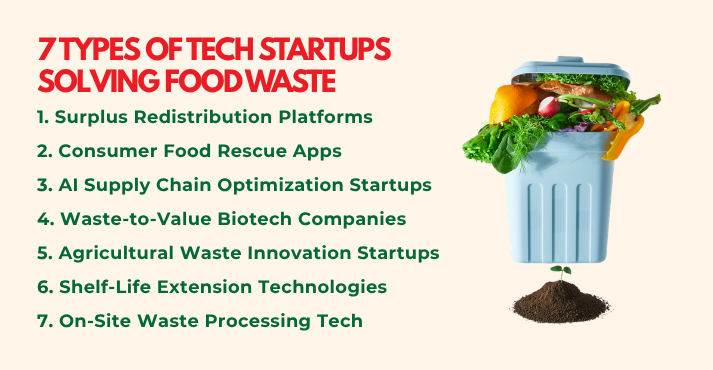
Here are 7 key types of tech startups solving food waste, along with real-world examples:
1. Surplus Redistribution Platforms
These surplus food redistribution platforms connect businesses with edible surplus to organizations that can collect and serve it quickly.
They solve the logistical problem of “who to give it to” and “how to get it there,” often using AI to optimize pickup and delivery routes.
For example, EatCloud uses AI to link supermarkets, restaurants, hotels, and others with food bank networks. WRI reports operations in Colombia and Mexico redistributing 40,000+ tons of unsold food (about 92 million meals), avoiding 85,000+ tons of carbon emissions, and saving customers $39 million+ via logistics savings and tax benefits.
Another example, Food Cowboy, is described as enabling food companies to donate surplus to charities (and route organic waste to composters, farmers, and biogas generators).
2. Consumer Food Rescue Apps
This category focuses on the “last mile” of the supply chain, empowering consumers to participate in waste reduction. These tools make waste reduction a habit.
For example, Froodly is described as showing about-to-expire supermarket products at 30–70% discounts.
Whereas CropMobster broadcasts alerts for surplus food deals or donations so subscribers can act before products spoil, blurring the line between bargain-hunting and community redistribution.
3. AI Supply Chain Optimization Startups
This category reduces the mismatch between supply and demand via forecasting, replenishment, and markdown timing.
According to WE Forum, retailers using Google Cloud include examples such as Carrefour and Coop, improving demand forecasting and inventory management. It also highlights AI-powered dynamic pricing engines; in partner shops, one such system cut food waste by 39%.
4. Waste-to-Value Biotech Companies
When food can’t be redistributed, biotech can convert it into inputs that displace more carbon-intensive alternatives.
Startups in this category apply biotechnology to transform inedible food waste into high-value commercial products.
For example, Chanz uses black soldier fly larvae to convert organic waste into animal feed and fertilizer. Also, WRI reports activity across Tanzania and Kenya with 10,000+ tons of organic waste collected and 250+ metric tons of methane prevented.
Moreover, AgriProtein Technologies is described as taking organic waste from food factories, restaurants, and hotels (plus out-of-date supermarket produce) and using it to feed larvae that become protein for chickens and farm-raised fish.
5. Agricultural Waste Innovation Startups
Focused specifically on the farm level, these startups address pre-harvest and post-harvest waste. They take agricultural residue, such as stalks, husks, or trimmings that would otherwise be burned or discarded, and add this upcycled food to soil-enhancing products that improve future crop yields.
For example, in food-tech startups in Southeast Asia, WasteX converts agricultural residues into biochar to improve soil performance and reduce fertilizer reliance.
6. Shelf-Life Extension Technologies
Rather than altering the food itself, these startups focus on the packaging and growing environments to drastically slow the clock on spoilage.
For example, protective fruit stickers coated with a plant-based antimicrobial substance can extend shelf life by up to two weeks.
Similarly, on-site hydroponic vertical farms that harvest-to-consumer in about 45 minutes, reducing food waste in that model from 40% to almost zero.
7. On-Site Waste Processing Tech
Instead of hauling waste to a centralized facility, these startups provide compact, localized technology that allows businesses, farms, or communities to process waste on the spot. This reduces transportation emissions and converts waste into usable resources immediately.
For example, compact, aerobic digesters that accelerate the breakdown of food waste into compost within hours or days, usable directly by the business or community.
Likewise, low-tech solar dryers are used to dehydrate crops, preserving them for future use without requiring refrigeration or industrial processing.
Why Investors Are Betting Big on Food Waste Startups
Food waste has unusually direct economics: businesses pay to buy food, then pay to dispose of what they don’t sell or use, so cutting waste protects margins.
Yet there is a major financing mismatch.
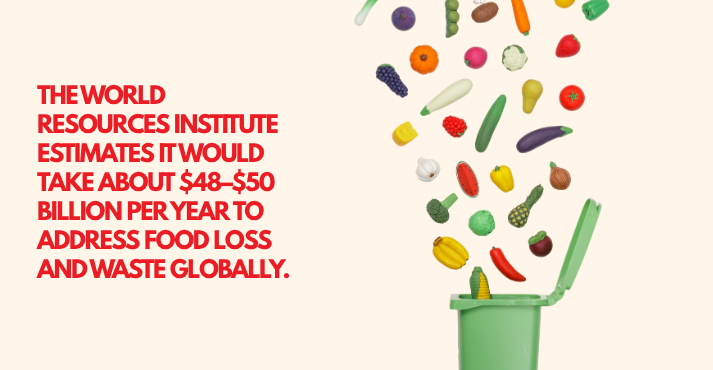
WRI estimates it would take about $48–$50 billion per year to address food loss and waste globally, while relevant solutions currently receive only about $0.1 billion per year in climate-related finance.
Investor interest is also shaped by provable returns; one consolidated fact sheet cites estimates of about $14 returned per $1 invested in food waste reduction, and by ESG reporting demand for auditable metrics.
Regulatory tailwinds matter too: mandatory composting and diversion rules for New York City, France, and South Korea.
Finally, carbon credits can strengthen unit economics for verifiable interventions; WRI reports WasteX can sell carbon credits to international buyers and share proceeds with farmers using its equipment.
Real-World Impact: Measurable Results from Food Waste Tech
Real-world impact and measurable results are as follows (drawn from the examples shared above):
EatCloud: 40,000+ tons redistributed (about 92 million meals), 85,000+ tons CO₂e avoided, $39 million+ in customer savings.
Chanzi: 10,000+ tons of organic waste collected, 250+ metric tons of methane prevented.
WasteX: fertilizer reduced by 50%, corn yields up to 95% higher in a reported trial.
Dynamic pricing (WEF-profiled): store food waste down 39% in partner shops.
Shelf-life stickers: fruit shelf life extended up to two weeks.
Challenges These Startups Still Face
While food waste tech startups are driving measurable impact, scaling these solutions across regions and value chains remains complex.
Several key challenges continue to limit their full potential:
- Funding gaps: Startups, especially in emerging markets, struggle to secure consistent investment. Returns often depend on behavior change or infrastructure upgrades, making investors cautious.
- Regulatory barriers: Food safety, liability, and transport regulations vary across regions, creating compliance hurdles and slowing cross-border scaling.
- Logistics complexity: Fragmented supply chains, lack of cold-chain infrastructure, and time-sensitive coordination make efficient redistribution difficult.
- Lack of data infrastructure: Limited standardized data on food waste hinders impact measurement, optimization, and demonstration of ROI.
Overcoming these barriers requires not just innovation but also supportive policy, infrastructure investment, and stronger collaboration across the ecosystem.
Future Trends in Food Waste Technology
The next wave of innovation in food waste management is moving beyond simple reduction toward fully optimized, intelligent systems.
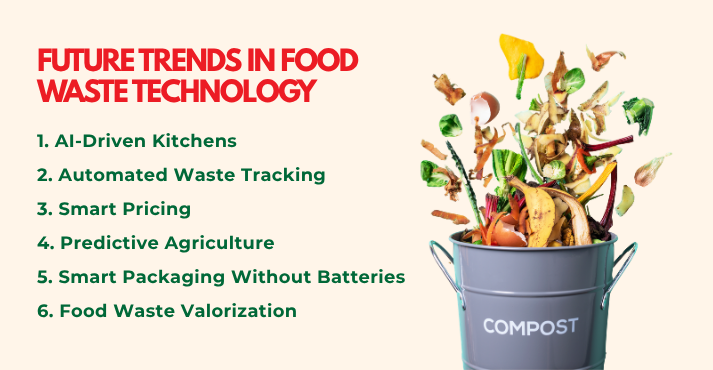
The future trends in food technology and waste management include:
1. AI-Driven Kitchens
Commercial kitchens are adopting AI-powered systems that analyze dish popularity, ingredient usage, and spoilage rates to optimize prep quantities and menu design.
2. Automated Waste Tracking
IoT-enabled bins with computer vision now identify and weigh discarded food in real time, giving businesses granular visibility into what gets thrown away.
3. Smart Pricing
Dynamic pricing engines, powered by machine learning, automatically discount perishable items as they approach sell-by dates.
4. Predictive Agriculture
Farmers are using satellite imagery, soil sensors, and hyper-local weather models to predict harvest volumes with unprecedented accurac
5. Smart Packaging Without Batteries
Next-generation packaging uses conductive inks and RFID technology to monitor freshness without built-in batteries.
6. Food Waste Valorization
Beyond composting, new biotech processes are extracting high-value compounds, proteins, fibers, and natural preservatives from food byproducts.
Who Benefits Most from Food Waste Tech Solutions?
Food waste technology creates value across the entire food ecosystem. Different stakeholders benefit in different ways, depending on where they sit in the value chain:
| Audience | Benefit |
| Restaurants | Lower food costs through better portion control, inventory management, and waste tracking |
| Retailers | Reduced shrinkage and higher margins by optimizing stock levels and selling near-expiry items |
| Governments | Improved sustainability reporting and progress tracking toward climate and waste reduction targets |
| Consumers | Access to more affordable food through discounts on surplus and near-expiry products |
| Farmers | Higher yields and better income through demand forecasting and new channels for surplus produce |
FAQs
How do startups reduce food waste?
Startups reduce food waste by preventing surplus (forecasting/pricing), rescuing edible food, extending shelf life, or converting scraps into feed, compost, or biochar.
What technologies help track food waste?
Technology helps track food waste through tools like AI analytics, IoT sensors, smart scales, smart bins, computer vision systems, inventory management software, blockchain tracking, and waste tracking apps.
Are food waste apps profitable?
Yes, food waste apps are profitable because business models include subscription fees, commissions on recovered food, and resale margins on discounted inventory.
What industries waste the most food?
A major share is at consumer-facing stages, households, retail, and food service, while large losses also occur between harvest and retail.
How does AI reduce food waste?
AI reduces food waste primarily by enhancing demand prediction, inventory control, and markdown timing. Machine learning models analyze historical sales, weather patterns, and local events to forecast demand with high accuracy, allowing businesses to order only what they will sell. Smart inventory systems then monitor stock levels in real time, flagging overstock before spoilage occurs. Dynamic pricing engines automatically apply discounts as products approach their expiration dates, accelerating turnover and minimizing waste.
Conclusion: The Future of Food Is Circular
Food waste is no longer just a problem; it’s an opportunity to rethink how the entire food system works.
With the rise of innovative technologies and startups, we are seeing a clear shift toward smarter, more efficient, and more sustainable solutions that turn waste into value.
From AI-driven insights to circular systems that reuse and regenerate resources, innovation is bridging the gap between sustainability goals and real-world action.
Importantly, businesses, governments, and consumers all have a role to play in adopting and supporting these solutions to create lasting impact.
The path forward is clear: invest in innovation, embrace circular practices, and rethink waste as a resource, not an endpoint.
The companies solving food waste today may end up feeding the world tomorrow.