Rising health awareness and a growing focus on digestive wellness are accelerating global demand for gluten-free ingredients.
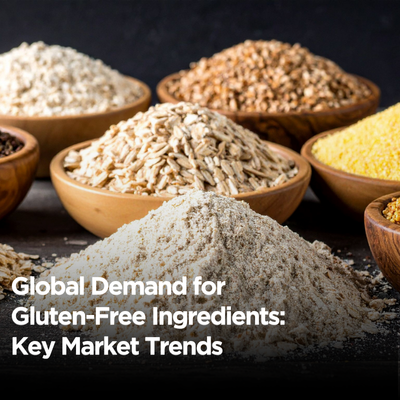
These ingredients include naturally gluten-free sources like rice, corn, and legumes, as well as specially processed components designed to remove gluten while meeting strict safety standards.
What was once driven mainly by medical needs, such as celiac disease and non-celiac gluten sensitivity, is now supported by the rise of clean-label, plant-based, and “better-for-you” food trends.
The global gluten-free ingredients market is evolving alongside this shift, with the gluten-free consumer market valued at over USD 8 billion in 2025 and projected to reach nearly USD 14 billion by 2034.
While North America currently leads due to strong retail infrastructure and high awareness, Asia Pacific is emerging as the fastest-growing region, fueled by rising incomes, increasing health awareness, and rapid retail expansion.
This guide provides strategic insight into the key market trends, consumer behavior shifts, and regional dynamics that manufacturers, investors, and suppliers need to capitalize on the rapidly evolving sector.
What Is Driving the Global Demand for Gluten-Free Ingredients?
Rising health awareness is driving growth in the gluten-free food ingredient industry.
For people with celiac disease, a lifelong gluten-free diet is necessary because gluten triggers an immune response that damages the small intestine. Also, people with non-celiac gluten sensitivity may feel better when they avoid or limit gluten.
That medical need has expanded into a broader lifestyle shift. As a result, demand is rising not just for finished products, but also for the gluten-free ingredients that food makers need to build them.
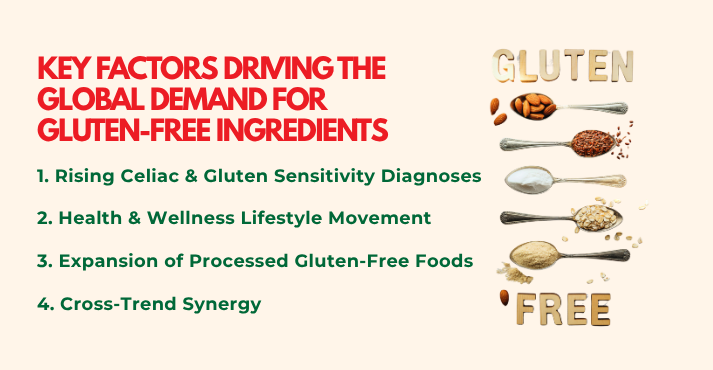
Key market forces driving the global demand for gluten-free ingredients:
1. Rising Celiac & Gluten Sensitivity Diagnoses
The wheat-free ingredients market is being driven by more people seeking products safe for celiac disease and gluten sensitivity.
The FDA’s “gluten-free” labeling standard (<20 parts per million of gluten), along with similar regulations globally, reinforces the need for controlled sourcing, careful processing, and celiac-safe ingredient demand across the supply chain.
2. Health & Wellness Lifestyle Movement
The modern gluten-free buyer is often motivated by wellness, not only diagnosis.
Consumers increasingly connect gluten-free eating with cleaner labels, easier digestion, and better overall food choices, which is helping the category move from a medical niche into a mainstream food and wellness market segment.
This is one reason “better-for-you” positioning continues to support gluten-free ingredient demand.
3. Expansion of Processed Gluten-Free Foods
Gluten-free ingredients market trends are also being shaped by the rise of processed gluten-free foods.
Bakery products and snacks continue to lead the category, while ready meals are also expanding, showing that gluten-free demand is moving well beyond packaged flour mixes into everyday meal formats.
Moreover, significant growth is also occurring in the foodservice and Quick Service Restaurant (QSR) sector. Consumer demand for healthier options has become non-negotiable.
4. Cross-Trend Synergy
A major growth driver is the overlap between gluten-free and other consumer priorities. Interest in plant-based gluten-free ingredients is rising as shoppers look for products that are also clean-label, non-GMO, or organic.
This means gluten-free now appeals to a wider group of climate-conscious consumers and health-focused buyers than it did in the past.
Key Demand Drivers at a Glance
| Demand Driver | What’s Happening | Impact on Gluten-Free Ingredients Demand |
| Rising Celiac & Gluten Sensitivity Diagnoses | More people are being diagnosed and seeking gluten-free diets | Increased demand for certified celiac-safe and wheat-free ingredients with controlled sourcing and processing |
| Health & Wellness Lifestyle Movement | Consumers choosing gluten-free for clean-label, digestive comfort, and better-for-you diets | Gluten-free ingredients are becoming a core part of the broader food and wellness market |
| Expansion of Processed Gluten-Free Foods | Bakery, snacks, RTE meals, and QSR/foodservice adoption broaden the addressable market | Higher need for functional gluten-free ingredients like flours, starches, and texturizers |
| Cross-Trend Synergy | Gluten-free + plant-based, non-GMO, and organic create premium multi-attribute products | Strong growth in plant-based gluten-free ingredients and multi-claim product innovation |
Market Size, Growth Rate & Forecast Outlook
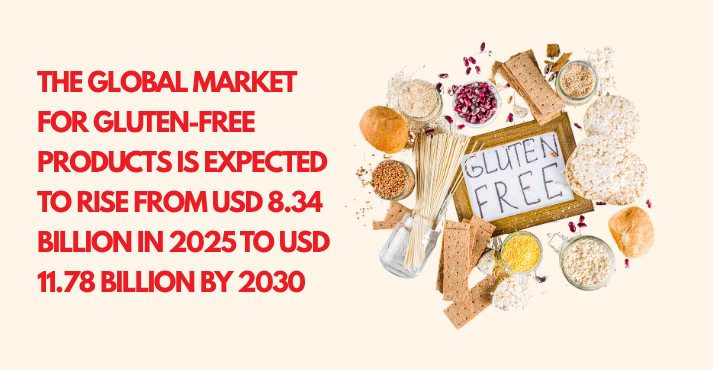
MarketsandMarkets projects the global market for gluten-free products to rise from USD 8.34 billion in 2025 to USD 11.78 billion by 2030.
For the gluten-free raw materials market, these forecasts signal continued demand for flours, starches, premixes, and functional substitutes that support gluten-free product development.
Market Growth Momentum
Historically, gluten-free demand expanded first through specialty bakery and packaged foods, then widened into more everyday formats as product quality improved.
The pandemic-induced surge established a higher baseline for the category, and sales continued to grow steadily, reflecting resilience even as market conditions fluctuated.
The market has since entered a phase of sustained, stable growth, with the category is maturing while still offering substantial expansion opportunities.
Investment Attractiveness
The gluten-free ingredient market is increasingly seen as a high-potential investment space, driven by its alignment with long-term food industry trends, such as health, clean-label demand, and product reformulation.
As global food companies continue to innovate and expand gluten-free portfolios, the need for specialized raw materials is creating consistent opportunities for capital investment across the value chain.
Key investment drivers include:
- Private equity interest: Growing focus on scalable, health-driven food categories with stable, repeat demand
- Food ingredient innovation: Continuous development of functional gluten-free flours, starches, and texturizers to improve taste, texture, and performance
- M&A activity: Increasing acquisitions in natural, plant-based, and specialty ingredient companies, signaling strong market consolidation and growth potential
Together, these factors position the gluten-free ingredient space as both resilient and innovation-led, making it attractive for long-term strategic investment.
Ingredient-Level Demand Analysis
Demand in the gluten-free ingredients market is not uniform. Different ingredients serve different price points, functions, and consumer needs, which makes ingredient-level analysis important for manufacturers and suppliers.
Some ingredients are chosen for premium nutrition and clean-label appeal, while others are valued for cost control, texture, or regional availability. This mix is shaping how gluten-free product developers build bakery items, snacks, and ready-to-eat formats.
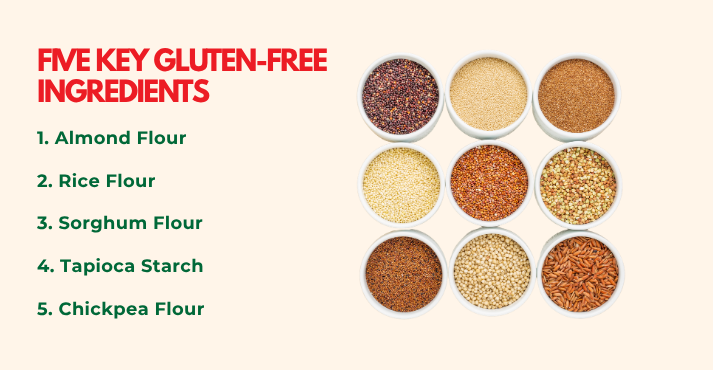
Here are the five key gluten-free ingredients that are driving innovation and capturing demand across global markets.
- Almond Flour: Emerged as a premium ingredient, almond flour is valued for its high protein content and is widely used in bakery applications such as cookies, cakes, and specialty breads.
- Rice Flour: A cost-effective and widely accepted base flour alternative, rice flour is especially common in Asia-Pacific markets where it supports mass-market gluten-free product development.
- Sorghum Flour: Known for its ancient grain appeal, sorghum flour also benefits from sustainable crop positioning, making it attractive for health-focused and environmentally conscious brands.
- Tapioca Starch: This ingredient is mainly used for texture improvement and binding functionality, helping gluten-free products achieve better softness, structure, and mouthfeel.
- Chickpea Flour: A high-protein alternative that fits well with plant-based synergy, chickpea flour is gaining demand in savory snacks, flatbreads, and protein-rich gluten-free foods.
This ingredient mix shows that gluten-free growth is being shaped not just by consumer demand, but by functional performance, cost considerations, and product positioning.
Comparison Table: Ingredient-Level Demand
| Ingredient | Application | Growth Outlook | Price Sensitivity | Regional Demand |
| Almond Flour | Premium bakery, desserts, keto products | Strong growth driven by premium and high-protein demand | High (premium-priced) | North America, Europe |
| Rice Flour | Base flour for bakery, noodles, snacks | Stable, high-volume growth | Low to medium (cost-effective) | Asia Pacific (dominant), global |
| Sorghum Flour | Bakery blends, health-focused products | Growing due to ancient grain and sustainability trends | Medium | North America, Africa, and emerging in APAC |
| Tapioca Starch | Binding, texture improvement in baked goods and snacks | Strong growth due to functional necessity | Low to medium | Southeast Asia, global manufacturing |
| Chickpea Flour | Snacks, flatbreads, plant-based foods | Fast growth driven by plant-based and protein demand | Medium | Middle East, India, North America |
Regional Demand Breakdown
The gluten-free ingredients market does not grow evenly across regions. While North America and Europe represent mature, highly regulated markets with established consumer bases, the Asia-Pacific region is emerging as the frontier of growth.
North America
North America remains the most mature market. The region’s market size is expected to grow from USD 2.72 billion in 2025 to USD 2.89 billion in 2026 and is forecast to reach USD 3.89 billion by 2031 at 6.15% CAGR over 2026-2031.
The U.S. FDA’s gluten-free rule also strengthens consumer trust by requiring foods labeled gluten-free, which supports strong labeling enforcement and higher standards.
Europe
Europe has one of the strongest demand bases for gluten-free products. The Association of European Coeliac Societies says 1-2 in 100 people in Europe are estimated to have coeliac disease, with more than 7 million people affected and only about 25% diagnosed.
On the market side, Europe is anticipated to reach USD 10.62 billion by 2035, growing at a CAGR of 10.28% from 2025 to 2035.
Moreover, the country also benefits from a steady stream of international tourists actively seeking certified gluten-free options, further reinforcing market demand.
Asia-Pacific
Asia-Pacific is the fastest-growing region. The market is projected to witness a CAGR of 9.14% during the forecast period 2025-2032, growing from USD 4.16 billion in 2024 to USD 8.37 billion in 2032.
The market is propelled by rising middle-class wealth across key economies, particularly in China, India, and Southeast Asian nations.
Importantly, a cultural and dietary advantage distinguishes the Asia-Pacific market: traditional rice-based diets provide a natural foundation for gluten-free eating.
Unlike Western markets, where gluten-free requires complete substitution of wheat-based staples, many Asian cuisines already center on rice, rice noodles, and rice flour, ingredients that are inherently gluten-free.
Regulatory & Certification Landscape
The regulatory environment plays a critical role in shaping the gluten-free ingredients market, especially as demand shifts from niche to mainstream.
Clear labeling standards and trusted certifications are essential not only for consumer safety but also for maintaining consistency across global supply chains.
Key regulatory & certification factors:
- Gluten-free labeling regulations: Most major markets have defined rules for what qualifies as “gluten-free,” helping protect consumers and standardize product claims across regions.
- <20 ppm gluten rule: Widely adopted in markets like the U.S. and Europe, this threshold ensures that products contain less than 20 parts per million of gluten, making them safe for most individuals with celiac disease.
- Role of Gluten Intolerance Group (GIG): Organizations like the Gluten Intolerance Group provide third-party certification (e.g., GFCO), offering an extra layer of trust beyond regulatory compliance and helping brands stand out in competitive markets.
- Certification requirement for B2B sourcing: In B2B transactions, certified gluten-free ingredients are often preferred or required, as they reduce risk, simplify audits, and ensure supply chain transparency for manufacturers.
- International regulatory variations: While many regions follow similar gluten thresholds, differences in labeling laws, enforcement, and certification requirements can create complexity for global suppliers and exporters.
Checklist: What Manufacturers Must Ensure
- Source ingredients from verified gluten-free suppliers
- Maintain strict cross-contamination controls during processing
- Ensure products meet the <20 ppm gluten threshold
- Obtain recognized third-party certifications (e.g., GFCO)
- Comply with region-specific labeling and export regulations
- Conduct regular testing and documentation for quality assurance
This regulatory framework is essential for building trust, ensuring safety, and enabling scalable growth in the global gluten-free ingredients market.
Competitive Landscape & Key Players
The gluten-free ingredient space is led by large global ingredient suppliers that combine scale, technical support, and formulation expertise.
Key players include:
Cargill
Offers certified gluten-free blends, flour alternatives, and ancient grain options for food and beverage manufacturers.
Archer Daniels Midland (ADM)
Provides gluten-free flour blends and specialty flours designed for clean-label and bread applications.
Ingredion
Focuses on gluten-free ingredient solutions that improve texture, structure, and eating quality in baked goods and snacks.
Here’s what is shaping competition in this market:
- Product innovation: Development of multi-functional flour blends, enzyme systems, and clean-label starches that mimic gluten’s structural properties in baked goods, pasta, and plant-based proteins.
- R&D investment: Dedicated application labs and pilot plants focused on optimizing texture, shelf life, and nutritional profiles for gluten-free formulations across bakery, snacks, and ready-to-eat categories.
- Strategic partnerships: Collaborations with certification bodies (e.g., GFCO) and industry directories to enhance supply chain transparency and provide verified ingredient sourcing for B2B customers.
- Regional expansion: Targeted capacity investments in Asia-Pacific and Latin America to capture fast-growing markets, including dedicated gluten-free processing facilities and local technical support teams.
Emerging Trends Shaping Future Demand
The next phase of growth in the gluten-free ingredients market is being shaped by evolving consumer packaged goods industry trends, where functionality, transparency, and personalization are becoming essential.
As brands move beyond basic gluten-free claims, innovation is now focused on improving nutrition, sustainability, and performance, turning gluten-free into a value-added category rather than just a dietary restriction.
Key trends to watch:
- Clean label reformulation: Brands are simplifying ingredient lists and removing artificial additives, pushing demand for naturally gluten-free, minimally processed raw materials.
- Functional gluten-free blends: Manufacturers are developing multi-ingredient blends that replicate gluten’s role in structure, elasticity, and texture, especially in bakery and snacks.
- Protein-enriched gluten-free flours: Rising demand for high-protein diets is driving innovation in flours made from chickpea, lentil, and other plant-based sources.
- Sustainable sourcing: Ingredients like sorghum and pulses are gaining attention due to lower environmental impact and alignment with consumer preferences.
- Direct-to-consumer (DTC) brands: Emerging gluten-free brands are leveraging DTC channels to offer niche, premium, and customized products, accelerating ingredient innovation cycles.
- AI-driven ingredient formulation: Food tech is enabling faster development of gluten-free products by optimizing ingredient combinations for taste, texture, and nutrition using data-driven models.
Gluten-Free + Plant-Based + High-Protein = Next Wave
The convergence of these three trends is defining the future of the market.
Products that combine gluten-free credentials with plant-based gluten-free ingredients and high protein content are expected to lead innovation, attract health-focused consumers, and shape the next wave of demand in the global gluten-free ingredients space.
Challenges & Market Constraints
Despite strong growth potential, the gluten-free ingredients market still faces several barriers that can slow adoption and increase operating pressure for manufacturers.
In many markets, these challenges also raise the final product price, which can limit wider adoption, especially in price-sensitive regions.
Key challenges and market constraints include:
- Higher production costs: Gluten-free ingredients and dedicated processing systems often cost more than conventional alternatives, increasing overall manufacturing expenses.
- Cross-contamination risks: Even small traces of gluten can make a product unsafe for sensitive consumers, so suppliers must maintain strict controls throughout sourcing, production, and packaging.
- Taste and texture challenges: Replacing gluten’s natural binding and structural role can make it harder to achieve the same softness, elasticity, and mouthfeel in finished products.
- Regulatory compliance complexity: Different regions have different labeling rules, testing standards, and certification needs, making global trade and sourcing more complex.
- Premium pricing barrier in developing markets: In cost-sensitive markets, higher retail prices can limit demand and slow the shift from niche products to mass adoption.
Investment & Business Entry Strategy
As demand expands across both developed and emerging regions, businesses that align production capabilities with evolving consumer needs will thrive.
Thus, success in this market is not just about offering gluten-free products, but about delivering consistent quality, certified safety, and application-ready ingredient solutions.
For Ingredient Manufacturers
- Capacity expansion: Invest in dedicated gluten-free processing lines and segregated storage to meet rising demand while maintaining certification integrity.
- Private label production: Partner with retailers and foodservice operators to supply store-brand gluten-free products, capitalizing on growing private-label penetration.
For Investors
- Identify high-growth segments: Target niche categories with premium potential, such as functional gluten-free snacks, high-protein alternatives, and organic-certified product lines.
- Focus on Asia-Pacific: Allocate capital to the region with the fastest projected growth, leveraging rising middle-class wealth and culturally aligned rice-based staples.
For Food Brands
- Product line extension: Expand existing portfolios with gluten-free variants of core offerings, minimizing development risk while capturing existing brand equity.
- Certification-first strategy: Pursue third-party certification (e.g., GFCO, AOECS) from product launch to build immediate consumer trust and streamline retail shelf acceptance.
5-Step Market Entry Framework
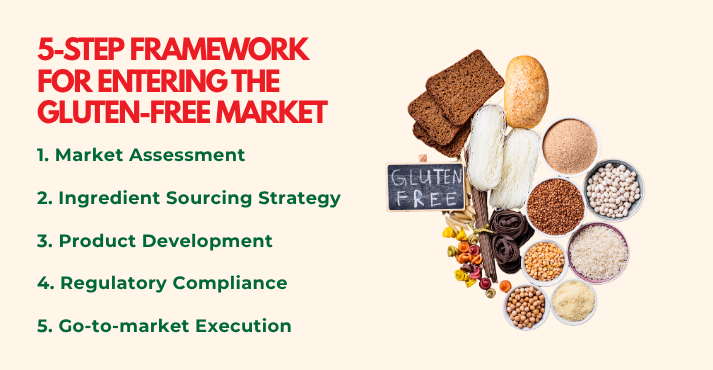
A structured approach is essential to enter and scale in the competitive gluten-free ingredients market successfully.
- Market assessment: Identify target regions, demand trends, and competitive landscape
- Ingredient sourcing strategy: Secure reliable, certified gluten-free raw material suppliers
- Product development: Focus on taste, texture, and functional performance
- Regulatory compliance: Ensure labeling, testing, and certification requirements are met
- Go-to-market execution: Leverage retail, foodservice, or DTC channels based on the target audience
This framework will help businesses reduce risk, accelerate entry, and build a strong foundation in the growing gluten-free ingredients market.
FAQs
What is the projected CAGR of the gluten-free ingredients market?
The gluten-free ingredients market is projected to grow at a CAGR of 8.2% from 2025 to 2033, reaching an estimated value of USD 17.2 billion by 2033. This growth is driven by rising health awareness, increasing diagnosis of gluten-related conditions, and expanding demand for clean-label and plant-based food products.
Which region has the highest demand?
North America currently leads in demand, driven by strong consumer awareness, high diagnosis rates of gluten-related conditions, and strict labeling regulations. However, the Asia-Pacific is the fastest-emerging region in the gluten-free ingredients market.
What are the most in-demand gluten-free flours?
The most in-demand gluten-free flours are driven by their functionality, nutrition, and versatility across food applications:
- Almond flour
- Rice flour
- Chickpea flour
- Sorghum flour
- Tapioca flour (starch-based)
What regulations define gluten-free labeling?
Gluten-free labeling is defined by regulatory standards that require products to contain less than 20 parts per million (ppm) of gluten to be considered safe. These rules are set by authorities like the U.S. Food and Drug Administration and are widely followed across major global markets.
How does gluten-free demand compare to plant-based trends?
Gluten-free and plant-based trends share common drivers; both are fueled by rising health consciousness, clean-label preferences, and a desire for dietary personalization, yet they differ in motivations and formulation. Gluten-free demand originates largely from medical necessity (celiac disease and non-celiac sensitivity), whereas plant-based eating is primarily driven by ethical, environmental, and perceived health benefits. In terms of market maturity, gluten-free has a longer history of regulatory definition and certification, while plant-based has seen more explosive recent growth fueled by innovation in meat and dairy alternatives.
Who are the top suppliers globally?
The following top suppliers dominate the global gluten-free ingredients market:
- Cargill, Incorporated
- Archer Daniels Midland (ADM)
- Ingredion Incorporated
- Dr. Schär AG/SPA
- EDME Food Ingredients Ltd
- MartinoRossi SpA
Conclusion: Strategic Outlook for 2030 and Beyond
Looking ahead to 2030 and beyond, the gluten-free ingredients market is positioned for sustained global demand, driven by the dual engines of rising medical diagnoses and proactive health-conscious adoption.
Innovation-driven competition will intensify as manufacturers race to overcome taste, texture, and nutritional formulation challenges, with those achieving sensory parity capturing significant market advantage.
Asia-Pacific expansion represents the defining geographic opportunity, where rising middle-class wealth, improving celiac awareness, and culturally aligned rice-based diets create the world’s fastest-growing market frontier.
Meanwhile, clean-label convergence, the integration of gluten-free with organic, non-GMO, plant-based, and sustainability claims, will increasingly define premium positioning and consumer trust.
Gluten-free is no longer niche. It is a structural category within the global food ingredient industry.